An Empire of Plants: People and Plants that Changed the World by Will Musgrave & Toby Musgrave
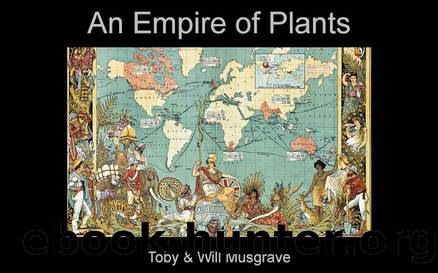
Author:Will Musgrave & Toby Musgrave [Musgrave, Will]
Language: eng
Format: azw3
Published: 2012-08-16T16:00:00+00:00
Chapter 5
The Fume of Poppies
The illicit opium trade of the 18th and 19th centuries offers a singularly inglorious example of economic forces in action. As Western supplies of silver bullion began to prove inadequate to export demands for Chinese tea and silk, the lucrative fields of Bengal were tapped to provide an alternative â albeit illegal â means of exchange. The East India Company remained officially unaccountable for the trade over which they exerted monopolistic control, as the drugâs impact permeated all levels of Chinese society. Defeat in the eventual Opium Wars was to prove disastrous for China, revealing to European powers the weakness of its empire in a predatory age. Subsequent indemnities and the enforced opening of Chinaâs ports to foreign trade did nothing to restrict the flow of opium; by the end of the 19th century mass addiction had become a symptom of the nationâs decline.
Plant Profile
Botanical Details
Classified in 1753 by Linnaeus as Papaver somniferum â âsleep inducingâ â the opium poppy is a herbaceous annual plant. The active principles of opium reside in its alkaloids, such as morphine, codeine and thebaine, which produce two remarkable effects: they relieve pain and induce euphoria. Before it is processed into purer morphine or heroin, the opium naturally contains between 7 to 15 per cent morphine, the primary active ingredient. It takes about 18,000 capsules grown in the space of 1 acre (0.4 ha) to produce just 20 lb (9 kg) of opium (although this yield can vary slightly according to temperature, light and time of harvest).
Origins
Native to Greece, southeastern Europe and western Asia, the plant has become established in many countries and is often viewed as a weed due to its habit of appearing among other crops. In the Mogul empire, two regions of India specialized in poppy cultivation. âBengal Opiumâ was grown along the Hooghly Valley to the north and west of Calcutta and on the western side of India âMalwa Opiumâ was produced from the countryside near Bombay. Grown commercially in countries such as China, Pakistan, Iran, Turkey, Afghanistan, India and Central and South America, the cultivation of the opium poppy, both licit and illicit, is now carried on chiefly across Asia, from Turkey to Laos.
Description
Reaching a height of 4 ft (1.2 m), the poppy produces fragile flowers of red, white, purple or violet with a span of about 8 in (20 cm). Opium is collected during the days between the fall of the petals and the maturing of the egg-shaped seed capsules. The source of the opium is the skin of the seed pod rather than the poppy seeds which, because they develop after the opium, are harmless.
Habitat
The poppy requires a temperate climate of approximately 45â73ºF (7â23ºC), and consequently when grown in tropical locations it is planted in the mountains at an elevation of 3,000 ft (900 m) above sea level. It grows best in a nutrient-rich, moist soil with a moderate annual rainfall of about 3 ft (I m). As a result of the work-intensive nature
Download
This site does not store any files on its server. We only index and link to content provided by other sites. Please contact the content providers to delete copyright contents if any and email us, we'll remove relevant links or contents immediately.
Sapiens: A Brief History of Humankind by Yuval Noah Harari(14389)
The Tidewater Tales by John Barth(12659)
Mastermind: How to Think Like Sherlock Holmes by Maria Konnikova(7343)
The Thirst by Nesbo Jo(6944)
Do No Harm Stories of Life, Death and Brain Surgery by Henry Marsh(6941)
Why We Sleep: Unlocking the Power of Sleep and Dreams by Matthew Walker(6723)
Life 3.0: Being Human in the Age of Artificial Intelligence by Tegmark Max(5558)
Sapiens by Yuval Noah Harari(5370)
The Body: A Guide for Occupants by Bill Bryson(5096)
The Longevity Diet by Valter Longo(5064)
The Rules Do Not Apply by Ariel Levy(4969)
The Immortal Life of Henrietta Lacks by Rebecca Skloot(4587)
Animal Frequency by Melissa Alvarez(4470)
Why We Sleep by Matthew Walker(4445)
The Hacking of the American Mind by Robert H. Lustig(4382)
Yoga Anatomy by Kaminoff Leslie(4363)
All Creatures Great and Small by James Herriot(4321)
Double Down (Diary of a Wimpy Kid Book 11) by Jeff Kinney(4269)
Embedded Programming with Modern C++ Cookbook by Igor Viarheichyk(4179)
